
Strategies for Enhancing Coping Skills
Some clients that you work with may exhibits challenges in managing difficult emotions at school and home. They may benefit from strategies to help them more effectively manage difficult emotions and enhance their coping skills.
Strategies to Enhance Coping
- Encourage your client to take a break and “self-calm” when they are feeling overwhelmed.
- Help your client recognize stress and uncomfortable feelings in their body and support them in developing coping skills.
- This may help them cope with stressors and challenges in healthy ways.
- Examples of calming strategies include:
- Taking deep breaths
- Counting to 10
- Imagining your favourite place
- Thinking of your favourite things
- Relaxing and tensing your muscles
- Help your client to label and define their feelings.
- When children are able to talk about how they are feeling, and what may be causing it, their emotions can feel more manageable.
- Encourage your client to get to know the signs their body gives them about what they are feeling.
- Help them identify things they can do when they are having uncomfortable feelings.
- Demonstrate and model ways of coping with different situations.
- For example, you could say, “I am going to take five deep breaths to help myself relax.”
- Model helpful thinking and encourage your client to use helpful thinking to cope with challenging situations.
- Helpful thinking is about promoting positive coping skills and encouraging children to feel good about themselves.
- This will help her to feel more confident in new situations.
- Encourage your client to challenge negative thinking with positive, helpful thinking.
- Continue to work on building your clients emotional and behavioural regulation capacity.
- They may benefit from fostering his/her emotional intelligence (i.e., his/ her ability to identify and manage his/her own emotions), and from developing healthy coping strategies (e.g., relaxation strategies to use during times of increased stress).
- Contingency management is a strategy that can be used to help improve behaviour problems.
- This involves establishing clear behavioural goals that gradually shape a child’s behaviour in a specific area of concern, developing a system to monitor whether the child is reaching these goals, reinforcing appropriate steps towards reaching these goals, and providing consequences for inappropriate behaviour.
- This strategy may be helpful in reducing your client’s video game use (if this is an area of concern).
- A technology use contract or behaviour contract may be beneficial in establishing clear and consistent goals:
- Technology use contract example: http://www.lorigetz.com/uploads/1/2/7/2/12729682/acceptable_use_policy_parent_child.pdf
- Behaviour Contract Example: https://www.understood.org/en/family/managing-everyday-challenges/daily-expectations-child/download-parent-child-behavior-contracts
- A technology use contract or behaviour contract may be beneficial in establishing clear and consistent goals:
- Encourage your client’s teachers to become aware of and recognize signs when your client is becoming dysregulated (i.e., frustrated; overwhelmed). Prompt them to use a self-calming strategy during times of need.
Anxiety and Stress Reduction Strategies
- Anxiety/stress can be reduced by changing the physical and mental state.
- Your client may benefit from incorporating some of these strategies into his daily life and during times of increased stress:
Anxiety and Stress Reduction Strategies
■ Practice mindful breathing. Breathe normally and count how many seconds it takes to completely exhale. Keep breathing and see for how many seconds you can extend your exhale. Repeat until your exhale is as long as it can possibly be.
■ Try using progressive muscle relaxation. This strategy reduces tension in the body that children may be holding on to, and creates a looser, more relaxed physical state. It involves going through different body parts and flexing and relaxing muscles.
■ Visualization strategies (e.g., guided imagery) may help Student settle their mind by temporarily shifting focus away from worries and concerns. For example, get them to imagine a “calming place,” with its sounds, feelings, colours, and contents.
■ Try playing the “5 Things Game.” This involves sitting comfortably where ever you are and thinking of five things you can feel, hear, see, smell, and taste. This can be done at any point throughout the day (e.g., in the car, in class, before bed, etc.). This is a quick mindful activity that helps re-orient a student’s mind to the present moment.
■ Consider engaging in regular exercise, particularly mindfulness-based exercise such as yoga.
■ Check your the Anxiety tab for more information related to anxiety strategies
Self Regulation Tools
These visuals that can be used to support children to become more effective at deep breathing
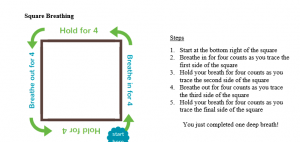
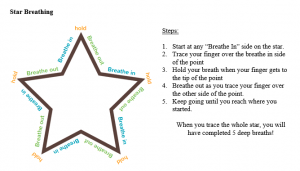
Additional Self-Regulation Tools: